LUMIBRIGHT
Retail & Jewellery Display Lighting
Application inspiration · not a project reference
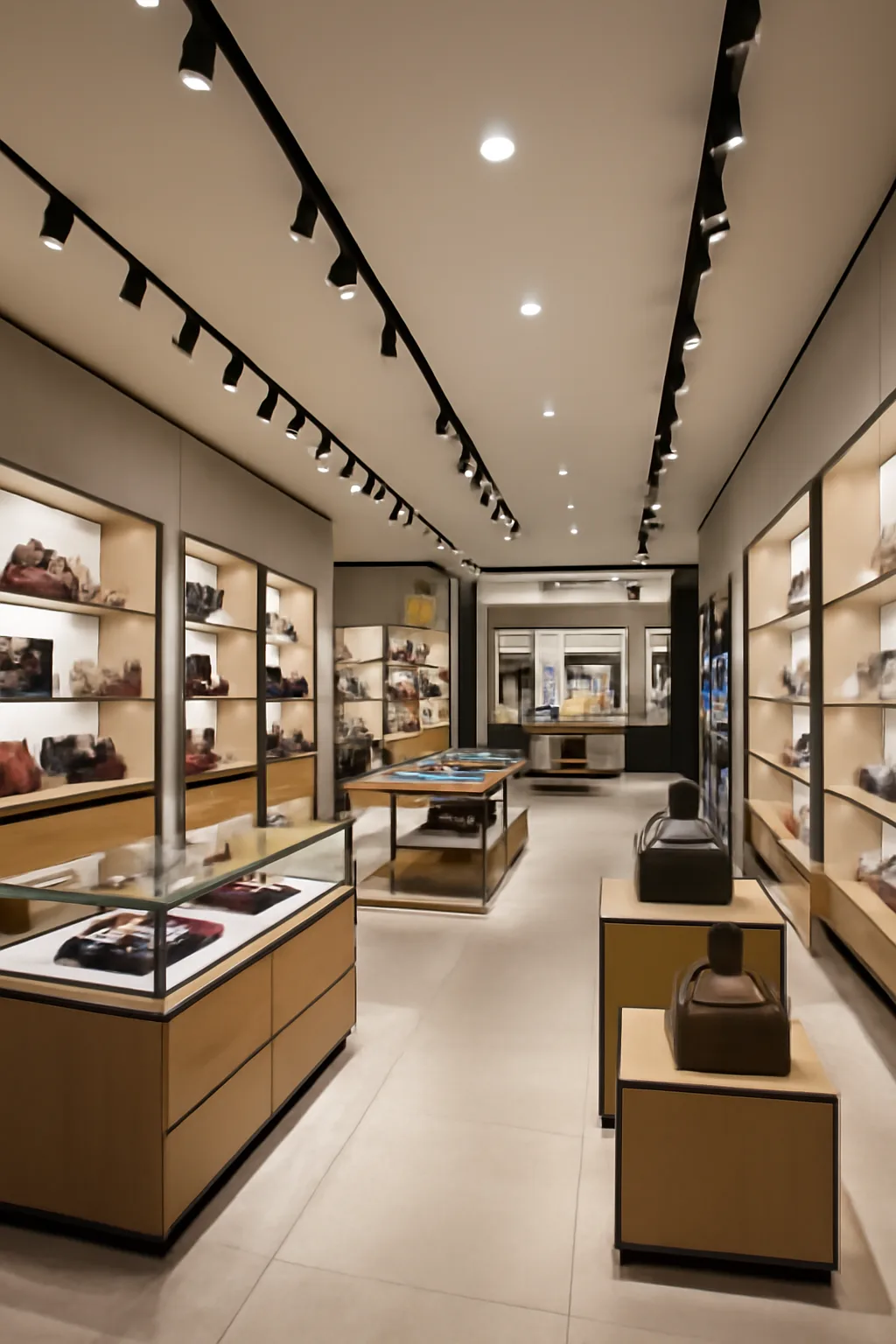
Retail lighting balances general illumination with emphasis on merchandise and displays. Layout, aiming and the relationship between light and materials should be coordinated with the exact models and the changing display scheme.
Design examples are starting points, not measured product results, guaranteed compatibility or universal regulatory minima. Confirm the exact model, site conditions, applicable standard and calculation with the responsible designer.
Design criteria
Lighting for retail interiors, vitrines and jewellery display
Retail lighting has one job: make the product the brightest, best-rendered thing in the room. That is a contrast exercise - a controlled ambient level, then accent light three to five times higher on the merchandise, with high R9 so reds and gold read correctly and tight optics so the case glitters instead of the ceiling. Jewellery adds a heat and sparkle requirement that decides the fitting more often than the lumen figure does.
| Zone | Illuminance | Uniformity | Colour | Glare | CCT |
|---|---|---|---|---|---|
| Shop floor (general)Keep ambient deliberately lower than the accent layer or the display disappears. | Illuminance300-500 lx | UniformityUo >= 0.4 | ColourCRI 90 | GlareUGR <= 22 | CCT3000-4000K |
| Feature / wall displayAccent ratio, not absolute lux, is what the eye reads as 'lit'. | Illuminance3-5x the ambient level | Uniformity— | ColourCRI 90, R9 > 50 | GlareHoneycomb louvre or snoot | CCT3000K |
| Jewellery vitrineSmall aperture, narrow beam (10-24 degrees) and low case heat; diamonds need a point source to sparkle. | Illuminance1000-2000 lx on the piece | Uniformity— | ColourCRI 95, R9 > 90 | GlareFully shielded, no visible LED | CCT3000-4000K |
| Fitting roomVertical light from the sides; a single downlight overhead is the classic mistake. | Illuminance300 lx vertical on the face | Uniformity— | ColourCRI 90+, R9 > 50 | GlareDiffuse, both sides of the mirror | CCT3000K |
| Window / façade displayDaytime windows compete with daylight - check the level again after dark. | IlluminanceAmbient-dependent, 2-4x interior | Uniformity— | ColourCRI 90 | GlareAim away from the pavement | CCT3000K |
Illustrative project-brief ranges, not measured model performance or universal code requirements. Confirm the relevant task, standard edition, site conditions and local requirements.
How to specify
Five decisions that set the fitting
- Set the accent-to-ambient ratio first (3:1 for fashion, 5:1 or more for jewellery), then pick the ambient level.
- For vitrines, specify the aperture and heat limit before the lumen package - a 24 degree, low-heat miniature spot beats a brighter fitting that warms the case.
- Ask for R9 explicitly. CRI 90 alone can still render reds and gold poorly.
- Use track or a modular system where the merchandising layout changes seasonally; use fixed trimless optics where it does not.
- Confirm the dimming curve at low output - retail schemes spend most of their life between 20% and 60%.
Specify from
Candidate families for technical review
1,483 articles across 12 families

Magnetic Light
MAGNETIC
191 articles
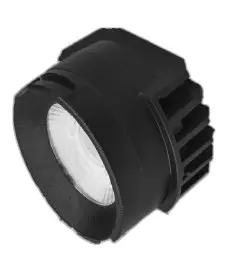
Modular Light
MODULAR
68 articles

Down Light
TUBE
47 articles

Spot Light
NICE
45 articles

Magnetic Light
OMNIA
40 articles
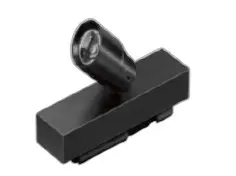
Magnetic Light
JOYERIA
36 articles

Magnetic Light
SLIMPSY
33 articles

Magnetic Light
TAZYIN
32 articles
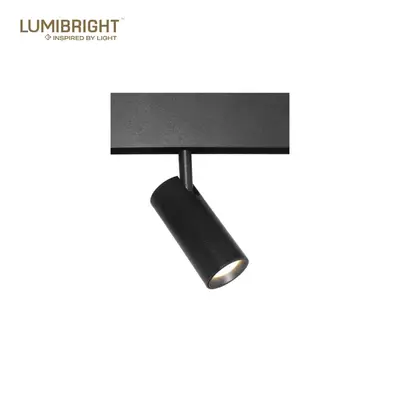
Magnetic Light
ILUME-DIM
29 articles
Magnetic Light
MARHET
28 articles

Spot Light
REFLEXO
28 articles

Spot Light
TRESCO
23 articles
Specifier questions
Frequently asked
What CRI and R9 should jewellery lighting have?
CRI 95 with R9 above 90 for diamond and gold display. R9 is the deep-red component that makes gold, rubies and skin tone read correctly; a CRI 90 fitting with low R9 will make a warm metal look flat.
What beam angle works inside a display case?
10 to 24 degrees from a small aperture. A point source creates the sparkle that sells stones; a wide, diffuse source removes it.
How do I stop display cases heating up?
Use miniature remote-driver spots with the driver outside the case, keep the wattage low and the beam tight, and check the stated ambient temperature (Ta) for the fitting.
Track or recessed spots for a retail fit-out?
Track (or a magnetic system) where the merchandising changes; recessed or trimless where the architecture is fixed. Both are available on the same optics and colour temperatures.